

Menu
Practical information for attendees inside devroom
Author
Practical information
Between each talk, after the Q&A, there will be 5 minutes for movements in and out of the room. Please wait the end of Q&A to start moving. As you can see the room cannot allow for constant movement of people. And it would be nice also if you could defragment the room when people leave, to keep the center filled.
- 5 min break between sessions
- Please wait the end of Q&A to start moving
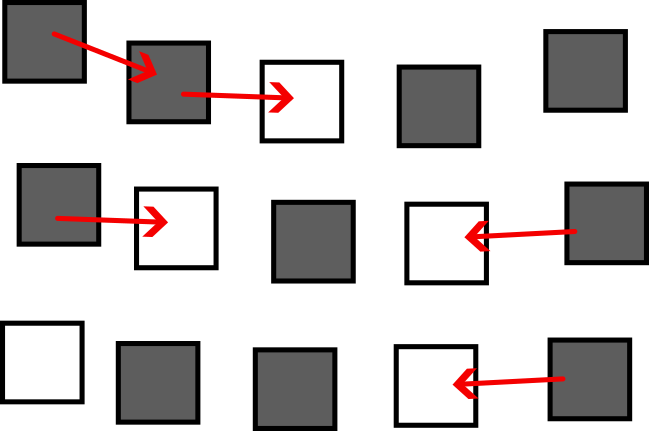
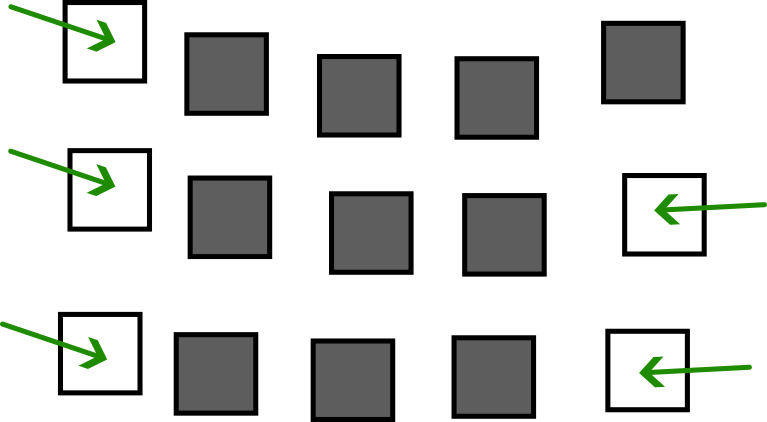
- Please defragment the room, meaning :
When empty seats in the middle of a row, please move towards the center, so that newcomers can take seats at the extremities.
Before
After
Room is full?
If the room is full, you can wait until the current talk is over, maybe there will be some seats available. You can also follow all the sessions with live streaming and even ask questions by using those links :
Questions & Answers
About Q&A sessions, they will be 5 minutes long. Please ask short questions that you think can be interesting to everyone. We also take questions from internet for remote viewers, by using Matrix. If you have more questions, please engage with the speakers outside of the room, and at the after party!
- 5 min long
- Please ask real and short questions
- Remote viewers can ask question via matrix (also if you’re in the room)
- use the matrix room #2026-local-first:fosdem.org
Recordings
As always at FOSDEM, the talks and Q/A sessions will be recorded. The recordings will be published under the same license as all FOSDEM content (CC-BY or CC-BY-SA). By asking a question at FOSDEM, you automatically give permission to be recorded.
Code of conduct
Following the release of the updated Code of Conduct for FOSDEM, we'd like to remind all speakers and attendees that all of the presentations and discussions in our devroom are held under the guidelines set in the CoC and we expect attendees, speakers, and volunteers to follow the CoC at all times.
Please report any infringement at
- E-mail: conduct@fosdem.org
- Phone (during the event only): +32 2 788 74 73
- Or ask any staff member during the event to help you locate a team member (people wearing blue, green, orange or yellow T-shirts with the FOSDEM logo on it).
Cleanliness
Please keep the room tidy, bring your trash to the bin located at the entrance door.
Please keep all your belongings with you, we cannot be made responsible for any loss or theft. If you find an abandoned or lost personal item, please bring it to the speaker's desk at the break.
When you leave the room, please take all your belongings with you, except if you are coming back shortly.
It is not allowed to eat in the devroom (unless we don't see you).
Cloakroom
There is a free cloakroom (in our building, we are lucky) and you can leave some of your belongings there. It is located on the ground floor, behind the main auditorium, here
After-party
Join us for some drinks later today starting at 17:30 in a café 10 min walk away from the devroom.
More details here.
OpenLocalFirst.org
Our website, will become a community-based resource center and an online meeting place for everything related to open local-first. We are also considering setting up a monthly community call. Please subscribe to the mailing list and our social accounts to get updates on that.
- Home for open source Local First communities
- Resource center
- Monthly community calls
- Subscribe to mailing-list and socials
- join #openlocalfirst:matrix.org
Feedback
On the FOSDEM website, you can give feedback to each speaker separately, and also in general about this devroom, from the homepage.
- For each talk you can leave feedback.
- Go to the page of the talk on fosdem.org website (from the schedule page) and click on the link “Submit feedback” at the bottom
- Within few days from now you can also write some general feedback about the devroom, directly on the homepage of FOSDEM website.
Why a local first devroom?
With more and more libraries, open source projects, companies and conferences dedicated to local-first related technology, it’s clear that Local First has become a hot topic over the last few years.
We’re really excited to now, for the first time, be able to host this full-day devroom at FOSDEM.
We want to thank the FOSDEM staff and all the volunteers for making this happen.
For those who are not too familiar with Local First, let’s try to do a 2-minutes introduction.
Introduction to Local First
The term was coined by Martin Kleppmann et al. in an essay published 6 years ago with the title “You Own Your Data, in spite of the Cloud“ (2019), but R&D started globally around 2010 with eventual consistency for distributed databases at scale.
I like to define Local First as the combination of offline-only (where you have the files on your disk), and online-only software (in the cloud).
From this fusion you also get for free: collaboration, both live and offline.
New paradigm
It’s a new paradigm for software development. Instead of using REST APIs in a client / server model, with GET, POST or PUT requests, Local First is all about SYNCing data.
The challenge of sync is how to deal with conflicts; multiple users updating data concurrently, and without coordination, sometimes even while being offline. The magic comes from using CRDTs, and I expect we’ll dive into this, quite a bit today.
We believe we can write better software using Local-First principles. Development becomes easier when most of the “data and network plumbing” is removed from the application layer. The data always lives on the user’s devices, and that brings interesting properties:
- ownership (no lock-in)
- availability (no internet is fine)
- speed (no loading time)
- privacy & security (E2EE)
Digital Sovereignty
In a world where digital sovereignty is becoming urgently needed, and where the domination of Big Tech on our lives should have been over, already long time ago, Local First comes as a perfect fit. It puts users back in control, and lets them exit the clouds and gatekeepers
The road ahead
- True decentralization
- Resilience
- Free the data
It took years for the local-first technology to mature and arrive to the rich ecosystem we now enjoy, but there is more work in front of us.
Today we will hear about the hard parts and the fun parts, the challenges and the achievements, and the big hopes that we all share for true decentralization, resilience, and freedom of data and software, for everyone.
Our program at a glance
A big thank you to the speakers, who came, for some of them, from very far away, and who are doing their very best to present you today the state-of-the-art.
CRDTs
In the program, we have the 3 main “generic” libraries for CRDTs.
- Yjs/Yrs with Bartosz at 9:30
- and with Yousef and Nick at 12:00
- Automerge with Brooke & Alex 10:30
- Loro mentioned by Ilya at 15:00
Then, we will learn how we can create new CRDTs, specific to the various application domains.
- Flec with Jim at 15:25
Frameworks & protocols
- Jazz with Giordano at 9:05
- Keyhive and Beelay with Brooke & Alex 10:30
- NextGraph with Laurin & Niko 11:00
- P2Panda with Andreas 12:30
- Teleportal with Nick 13:55
- OCapN with David 14:05
- Willow with Sammy 15:55
- Hypermedia with Eric 16:40
Databases
- Jazz with Giordano at 9:05
- NextGraph with Laurin & Niko 11:00
- ElectricSQL with Kevin 11:30
- OrbitDB with Nico 14:40
- PouchDB with Alex 16:20
Applications
- Plane WIKI with Palani 10:00
- Reflection with Tobias 12:30
- Teamtype with blinry & Moritz 13:00
- Radicle with Fintan 13:20
- Miru with Taye 13:40
- Collabora comments with Michael 13:50
- SQLRooms with Ilya 15:00
- Seed with Eric 16:40
UX and UI
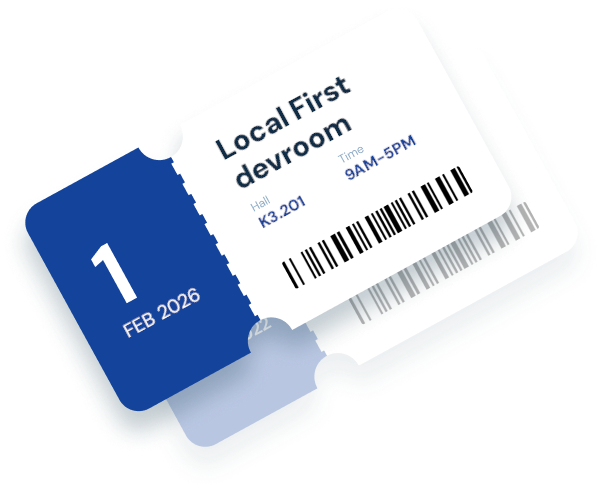
Local-First is the future of app development!